
Buying Off-Plan in Ghana From Abroad: How to Vet a Developer Before You Pay
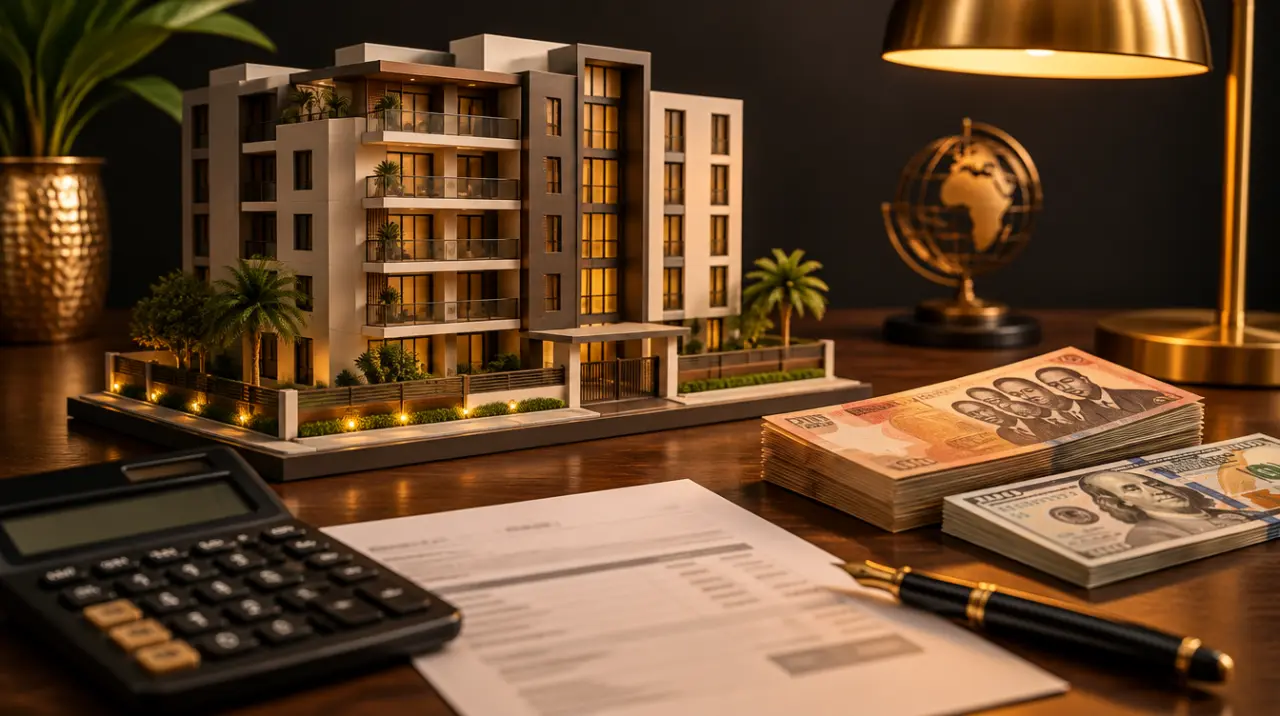
Buying a home off-plan lets you secure a new apartment or townhouse in Accra at today’s price and pay in stages while it is built. For Ghanaians abroad it is often the most practical route into the market. It also carries the biggest risk in Ghanaian real estate: paying a developer for a home that arrives late, or not at all. Here is how to check a developer properly before you pay a single cedi or dollar.
Key takeaways
- Only deal with developers and agents licensed by the Real Estate Agency Council (REAC) under the Real Estate Agency Act, 2020 (Act 1047).
- Check the land under the project, the building permit and the developer’s track record before you sign.
- Tie every payment to a construction milestone, pay by bank transfer to the company, and never pay cash.
- Have a Ghana-based lawyer review the sale and purchase agreement and limit any power of attorney you sign.
Why buyers choose off-plan, and what can go wrong
Off-plan homes are usually cheaper than the same unit once finished, and payment plans spread the cost. Developers in Accra commonly ask for an initial deposit of 10% to 30%, with the balance paid in stages over 12 to 36 months and the final payment due at handover.
The trade-off is that you are funding a building that does not exist yet. Ghanaian lawyers regularly see cases where buyers paid in full but the developer could not finish on time or at all, often because the developer ran short of money. Title disputes under the land are the other big risk. The steps below address both.
Step 1: Check that the developer is licensed
The Real Estate Agency Act, 2020 (Act 1047) regulates the sale, purchase, rental and leasing of property in Ghana. It covers developers, brokers, agents, property managers and marketers, and makes the Real Estate Agency Council the regulator. REAC licenses practitioners, keeps a national register and publishes lists of those in good standing.
- Ask for the developer’s REAC licence and check it with REAC directly. In October 2026 the Council’s acting chief executive urged the public to “engage with only REAC-licensed agents, brokers, and developers”.
- Know the rules they must follow. Licensed practitioners must work without cash, keep client money in separate accounts and file regular reports. REAC officials have said that providing real estate services or advertising without a licence is a criminal offence, with penalties of 5,000 to 10,000 penalty units or five to ten years in prison.
- Look for industry membership. Membership of the Ghana Real Estate Developers Association (GREDA) is not a guarantee, but its absence is worth asking about.
Step 2: Check the land under the project
Your home is only as secure as the developer’s title to the site. Before you sign:
- Ask for the developer’s land title or head lease for the whole site, and a recent Lands Commission search report on it. If the land is not in the developer’s name, ask for the landowner’s written consent to the development.
- Ask for the building permit from the local assembly and, where required, the Environmental Protection Agency permit.
- Search the Collateral Registry to see whether the site has been pledged against a loan.
- Confirm the lease term you will receive and how your own lease will be registered at completion.
Our guide to verifying a land title in Ghana explains each of these checks in detail.
Step 3: Look at what the developer has already delivered
- Visit at least one completed project by the same developer. Look at the finishes, the common areas and how the building is being maintained.
- Speak to previous buyers. Ask whether they received their homes on time and to the agreed specification, and whether their titles were registered.
- Ask how the project is financed. A developer relying entirely on buyers’ deposits is more exposed if sales slow down.
- Check the company’s registration and the identity of its directors.
Step 4: Read the sale and purchase agreement carefully
The sale and purchase agreement (SPA) is the document that protects you if things go wrong. Have a Ghana-based lawyer review it and make sure it covers:
- The full price, the currency, and whether VAT and other charges are included.
- A payment schedule tied to construction milestones (foundation, structure, roof, finishes, handover), not just calendar dates.
- A firm completion date and a penalty or compensation if the developer is late.
- Your remedies if the developer defaults, including refunds.
- A detailed specification schedule: finishes, fittings, power backup, water storage and parking.
- The lease term, the service charge and who manages the building after handover.
- How and when your interest will be registered at the Lands Commission.
Step 5: Pay safely, against progress
- Pay by bank transfer to the developer’s company account, never to a personal account and never in cash. Under REAC rules, licensed practitioners should not accept even GH₵1 in cash.
- Release each payment only when the matching milestone is complete. Ask for dated photos and videos, and ideally an independent report from a surveyor or engineer you appoint.
- If a developer offers an escrow arrangement held by a bank or a law firm, it adds a useful layer of protection.
- Keep every receipt and statement. They are your evidence if there is ever a dispute.
Step 6: Buying from abroad? Limit your power of attorney
Most diaspora buyers appoint someone in Ghana to act for them. A power of attorney is signed before a notary where you live and then authenticated for use in Ghana, as your lawyer and the nearest Ghana mission advise. Keep it tight: name the property and the transactions it covers, set a monetary limit and an end date. Misuse of a broad power of attorney is one of the most common ways diaspora buyers lose money. The Lands Commission’s online services also let you follow a search or registration from abroad.
What it costs on top of the price
| Cost | Typical amount |
|---|---|
| Stamp duty (Ghana Revenue Authority) | 0.25% to 1% of the value |
| Legal fees | About 1% to 2% of the price |
| Lands Commission search and registration | Official fees in the hundreds of cedis, plus your lawyer’s time |
| Service charge after handover | Commonly GH₵800 to GH₵1,800 a month in gated developments |
| Tax on rent, if you let it out as a non-resident | 15% of gross rent |
As a rule of thumb, budget an extra 5% to 10% of the purchase price for buying costs.
Lease terms: citizens and non-citizens
Ghanaian law does not allow freehold ownership of land by non-citizens. Under Article 266 of the 1992 Constitution, a non-citizen can hold a lease of up to 50 years, renewable, while Ghanaian citizens (including dual citizens) typically receive leases of up to 99 years. Check the exact term in your SPA and your lease.
Red flags
- Pressure to pay a large deposit before you have seen the title and permits.
- Requests to pay into a personal account or in cash.
- No REAC licence, or reluctance to show one.
- No completed projects you can visit.
- An SPA with no completion date, no delay penalty and no refund terms.
- Promises of “freehold” ownership.
Plaisir Realty
Check the developer before you pay
Plaisir Realty has spent more than sixteen years inside Ghana’s property market, working with developers on how their homes are marketed and sold. Our real estate data hub brings together developer profiles, project ratings, price trends and title checks, so you can compare developments on facts rather than brochures. We also review sale and purchase agreements and land documents free of charge for our buyers. Start your search with Plaisir Realty.
Frequently asked questions
Is it safe to buy off-plan in Ghana?
It can be, if you buy from a licensed developer with a track record, check the land and permits, and pay against milestones under a well-drafted SPA. Most losses happen when buyers skip these checks or pay too much up front.
How do I check if a developer is licensed in Ghana?
Ask the developer for their Real Estate Agency Council licence and confirm it with REAC, which keeps a national register of licensed practitioners.
How much deposit do Accra developers ask for?
Typically 10% to 30% of the price, with the rest paid in stages over 12 to 36 months. Avoid any plan that asks for most of the price before construction is well advanced.
Can I buy property in Ghana without travelling?
Yes. Many buyers abroad complete purchases through a Ghana-based lawyer and a limited power of attorney, and follow searches and registration through the Lands Commission’s online services.
Sources: MyJoyOnline, REAC compliance webinar, October 2026; Graphic Online, October 2025; Mondaq, buying off-plan in Ghana, 2024; MyJoyOnline, June 2026; MyJoyOnline, March 2026. This article is general information, not legal or financial advice.